Does Charging OFF via CAN work with Victron?

As usual, please correct me if I’m wrong.

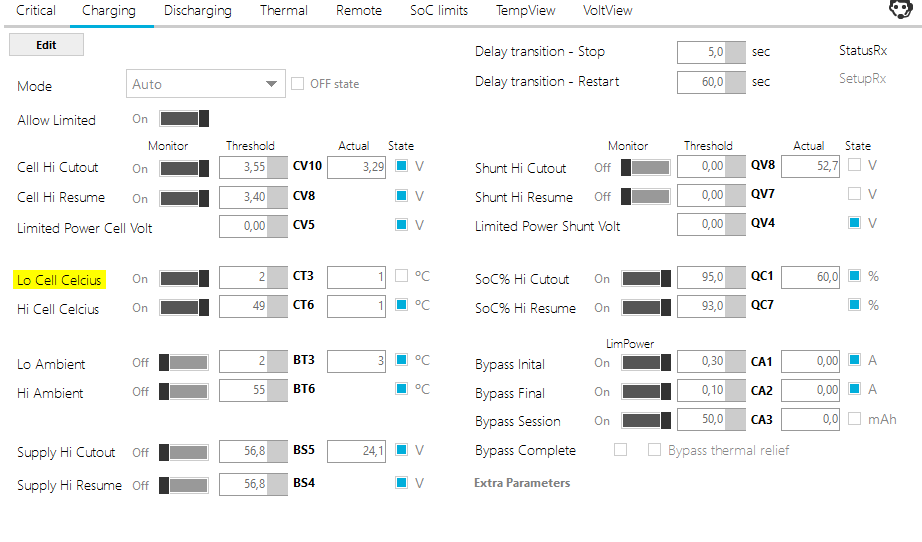
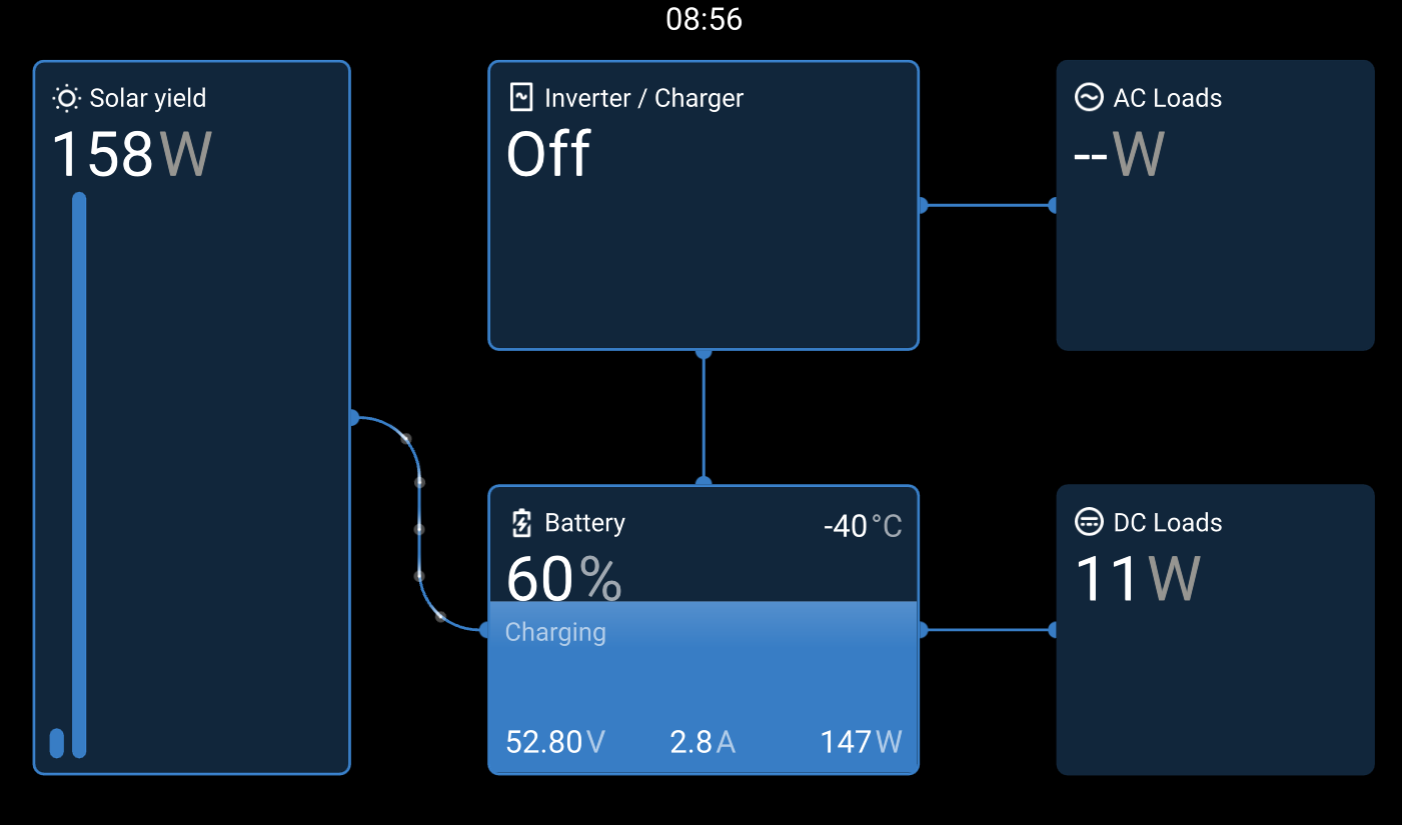
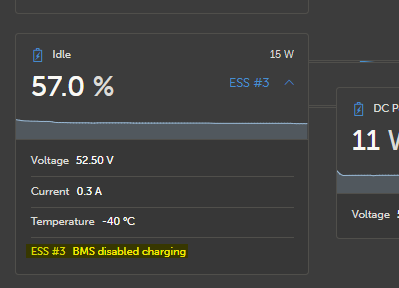
In addition to issues with temperatures around 0 °C being read incorrectly by Batrium and incorrect values being sent to Victron, I’ve discovered that even when Batrium switches to Charging OFF due to temperature (as shown in the Toolkit), Victron does not react and continues to receive remote values as if full charging were allowed (on the picture below, the inverter is switched off manually by me).

If this is confirmed, it would mean that the BMS does not actually protect the battery over CAN in Victron, and the only reliable solution would be to disable the MPPT chargers via a dedicated expansion board contact.

James, when will these bugs be fixed? The last firmware update was released over a year ago.


I’ve been running a Batrium on a Victron system for a few years now. MM5.

I rely almost exclusively on the BMS CAN communication for all protection.

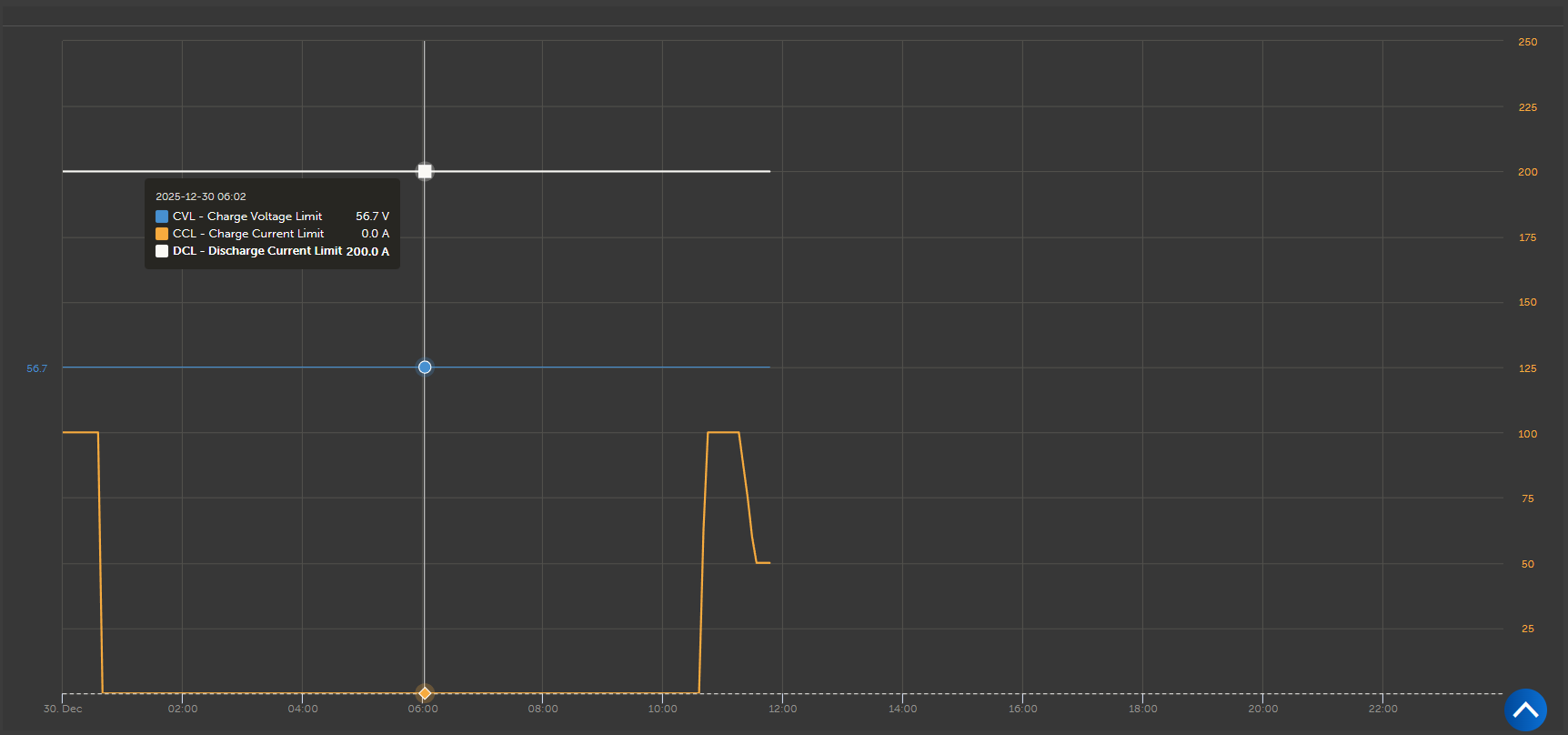
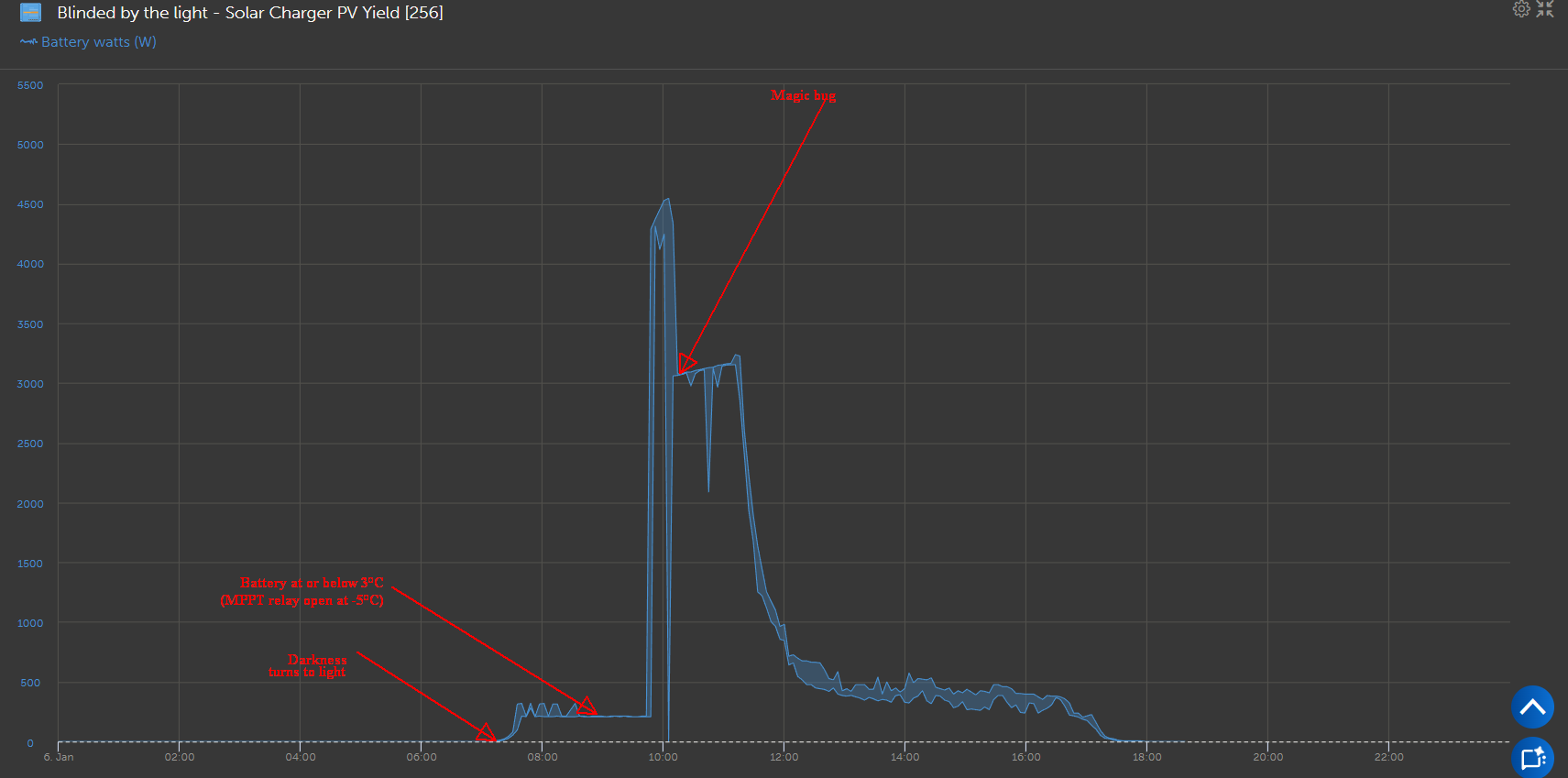
I routinely observe my unit command a 0A CCL to the GX device, and I observed my MPPT only provide enough watts to power my loads - not charge the battery. Once the battery temperature rises a few degrees, the MPPT takes off like gangbusters.

I am NOT using Dynamic Volt Targets. I am using the High/Limited (Original) template.

Have you confirmed the system responds correctly using a different template?

Battery critical temp condition opens the circuit on the MPPT completely turning it off. I have confirmed this works as well on multiple occasions.

Is your GX device on the latest firmware?

Hi snobbler, thanks for your suggestion. I’ll give the other templates a try. Mine is a WatchMonCORE, and the GX is running v3.70~61.

You are on beta GX firmware. The current one is 3.67. Recommend you downgrade to the stable version. You should also likely report this as a bug to Victron.

IIRC, once you have a beta firmware running, you have to manually download and install the stable release.

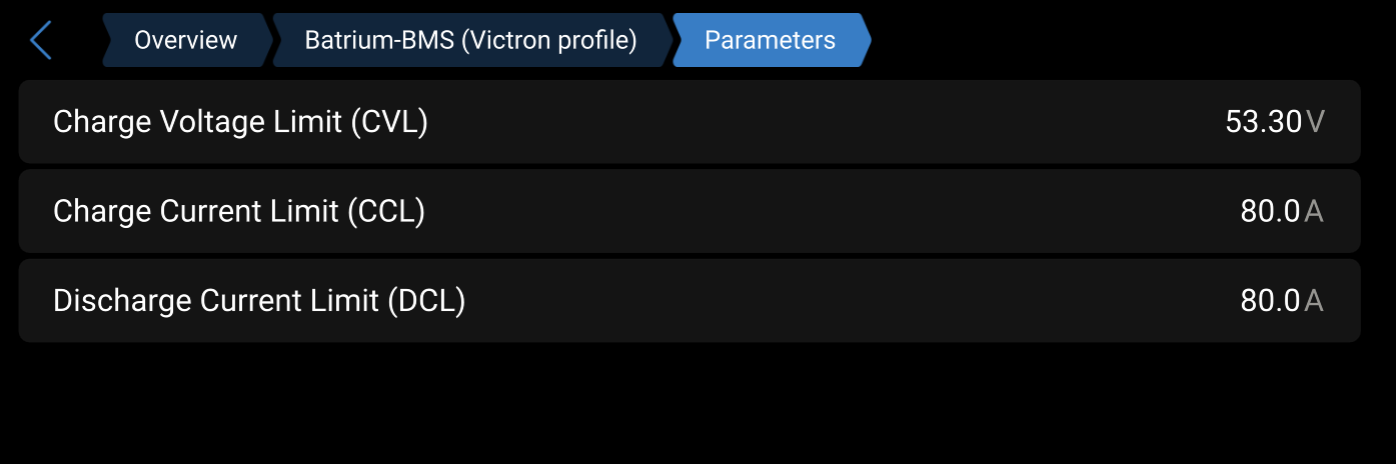
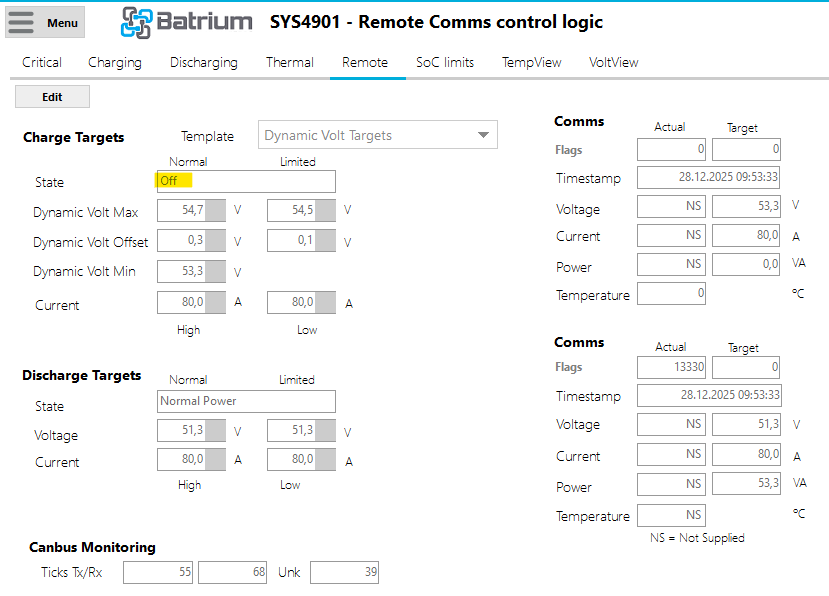
I tested several charging-disable scenarios at low temperatures using different remote charging templates, as well as both beta and stable GX firmware versions. I also tried manually switching charging off on the Charging tab. None of these methods worked — in every case, the CCL transmitted by Batrium to Victron remained at the configured 80A.

Eventually, I found a solution.
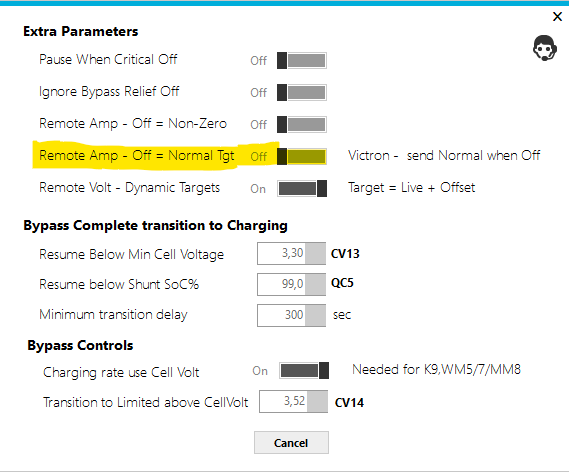
In the Charging tab → Extra Parameters, I switched the toggle from “Victron – send Normal when Off” to “Remote Amp – Off = Normal Tgt”. After this change, Batrium started sending zero CCL values to Victron when the “Lo Cell Celsius” parameter was active. This is strange, as it appears to contradict the recommendations in the Batrium Wiki.
https://wiki.batrium.com/en/victron-dvcc


In summary: I am not sure whether this behavior is intentional or a firmware bug, but when the switch is set to “Victron – send Normal when Off”, Batrium does not protect the battery and does not disable charging when the temperature drops below the limit.

Dynamic Voltage Targets and especially the setting “Remote Amp - Off = Normal Target” are meant for Victron ESS systems connected to a grid for grid feed-in. If grid feed-in from DC is enabled in that energy storage system, CCL has no effect at all and solar chargers provide their maximum power, which is then sent to the grid. Setting CCL to whatever value has no effect in those systems.
If you need to set CCL to 0A, you already found the solution for yourself.

1 Like

Hi Witold,

Kleini is correct here.

To summarise:

  • The limits you set in the Control > Charging tab determine whether the charging state is On, Limited or Off
  • The limits you set in Control > Remote determine the limits that get sent over to Victron via CAN, depending on the charging state. e.g. Off will limit charge voltage to the shunt voltage, preventing charge.
  • The “Remote Amp Off = Normal Tgt” setting will send a normal charge limit when off, so that grid feed can occur in Victron systems when the battery is full. BUT there is one last check of high cell and shunt voltages for safety, as this is the main cause for fires in battery systems. If it is over voltage 0A will be sent instead. This is what the CV10 comment refers to in the wiki.

This is all due to Victron’s DC coupled model. If we just sent 0A as CCL, then solar chargers would shut off when the battery was full or cold, and not power the inverters on a marine or terrestrial system. To be clear charge would be stopped by CVL instead in this scenario.

Let me know if I can explain anything more!

James,

I may be missing something in this context as I’m not working with any ramped anything, but CCL 0A will not cause the MPPT to shut down. The GX interprets CCL as a CHARGE limit, not an MPPT output limit. I routinely get CCL 0A due to cold temps, and the MPPT happily powers everything maintaining a very slight draw on the battery.

Hi James,

controlling the system via Batrium depending on voltage levels is something I have reasonably well under control, and it was not a cause of concern for me. What I initially could not achieve or find in the Wiki was disabling battery charging at low temperatures.

Currently, with the settings from my last post, when the temperature drops below the lower threshold, battery charging is cut off, ESS#3 is triggered in Victron system and the MPPTs only support powering the system and the loads. This is a major advantage compared to disabling the MPPTs via the Remote ON/OFF contact, because using that contact completely shut down the chargers.

Hi Snoobler,

Hmm, keen to learn more about this.

Have you got DVCC enabled and your MPPT hooked up to the GX? Any ESS settings turned on?

Are you feeding to the grid in the scenario you mentioned?

WM5. FW 5.10.104
Toolkit 2.17.57
CCGX FW 3.55 (highest allowed on CCGX)
DVCC on
Deployed 7/2022, 23.3kWh 14S NMC battery.

Off grid, so ESS is pure insanity for me. The Victron instructions on your site are just plain wrong. This was well before DVCC was auto-enabled when it sensed an attached Batrium.

No grid interaction, so that’s why I confessed to potentially missing something in this context. I can only recognize ESS when it’s spoken. I can’t speak it.

MPPT is hooked to GX. CHARGE control limit (CCL) 0A = the GX does not alloy CHARGING. It’s not perfect, but they seem to favor a very slight draw (<1A draw from the battery), but rapid load changes can cause very brief charging.

The only thing that shuts down the MPPT completely is critical temp and voltage. Expansion board opens the circuit to the MPPT control relay.

It is my understanding that this is the expected behavior. It’s limiting CHARGE current, not MPPT output. Even on a lead acid battery, you can set a CCL in DVCC, and it will prevent all GX connected chargers from exceeding the CCL current. So you can limit your puny FLA battery to 30A charge, but still get the max 100A out of your MPPT.

On another matter… I have found what I suspect is a bug, but it offers the functionality I want. I would like to tell you about it, but I don’t want it taken away… :smiley:

Unrelated to the bug, but kinda… The Batrium system is complex, so I don’t grasp a lot of it, mostly because I don’t need it, and because I’m old and lazy, and I can’t figure things out like I used to.

It’s my understanding that Batrium was developed primarily around 3.7V chemistry and has needed adaptations to make it more suitable for LFP as you don’t want low current overcharge holding LFP at peak voltage.

Given that there is substantial cycle life improvement by reducing depth of the charge/discharge of NCA/LMO/NMC chemistries (20%-75%), there HAS to be a way to manage the battery thusly and do so automatically. I mean surely someone has asked for this in the past?

For my particular variation of NMC chemistry (NMC-LMO blend), 3.92V is 75% SoC. I never want to go above this unless I know I need the extra capacity, and I rarely do. The site rarely uses more than 10kWh/day and with 6kW PV available in sunny AZ, I don’t use up a lot of battery capacity. Since I can’t figure out how to sync to a value at a given target (only 100%), I’m continuously resetting my SoC back down to 75% every week or so as it creeps up even without balancing.

Thoughts?
Hi Snoobler,

I completely understand your comment around the Victron instructions - it’s been a while since we’ve had physical access to a customer’s Victron system to make docs from. We recently invested in a new Victron test system, so expect new docs in the coming weeks.

It sounds like CCL is behaving as expected. In your case it seems like Victron is adding up our CCL sent over CAN with the wattage your loads need, and asking for that from the MPPT.

The problems arise for the folks using ESS on-grid. Victron does the same thing - add up the CCL (0 when full) and the loads (some small number), and ask the MPPT for that, rather than the maximum solar production available, knowing the excess can be fed to the grid.

In short, you don’t need the “Remote Amp Off = Normal Tgt” setting turned on, since you’re not trying to feed every spare kWh to a grid.

Does that make sense? Happy to explain further if required.

Also, regarding chemistry, most of the systems built with our products are LFP these days, and we can support any arbitrary lithium or sodium chemistry, as all our thresholds are configurable. Try lowering the Charge Resume SoC% if you would like your loads to drain the battery a bit before starting another cycle.

Yep. Sounds like I was missing something in this context. :smiley:

No. I don’t want any additional explanation… the grid will never touch my system. It’s over half a mile away, and I can expand my system by a few multiples before I hit the connection charge. :smiley:

MPPT behavior on “cold battery” days:

1 Like